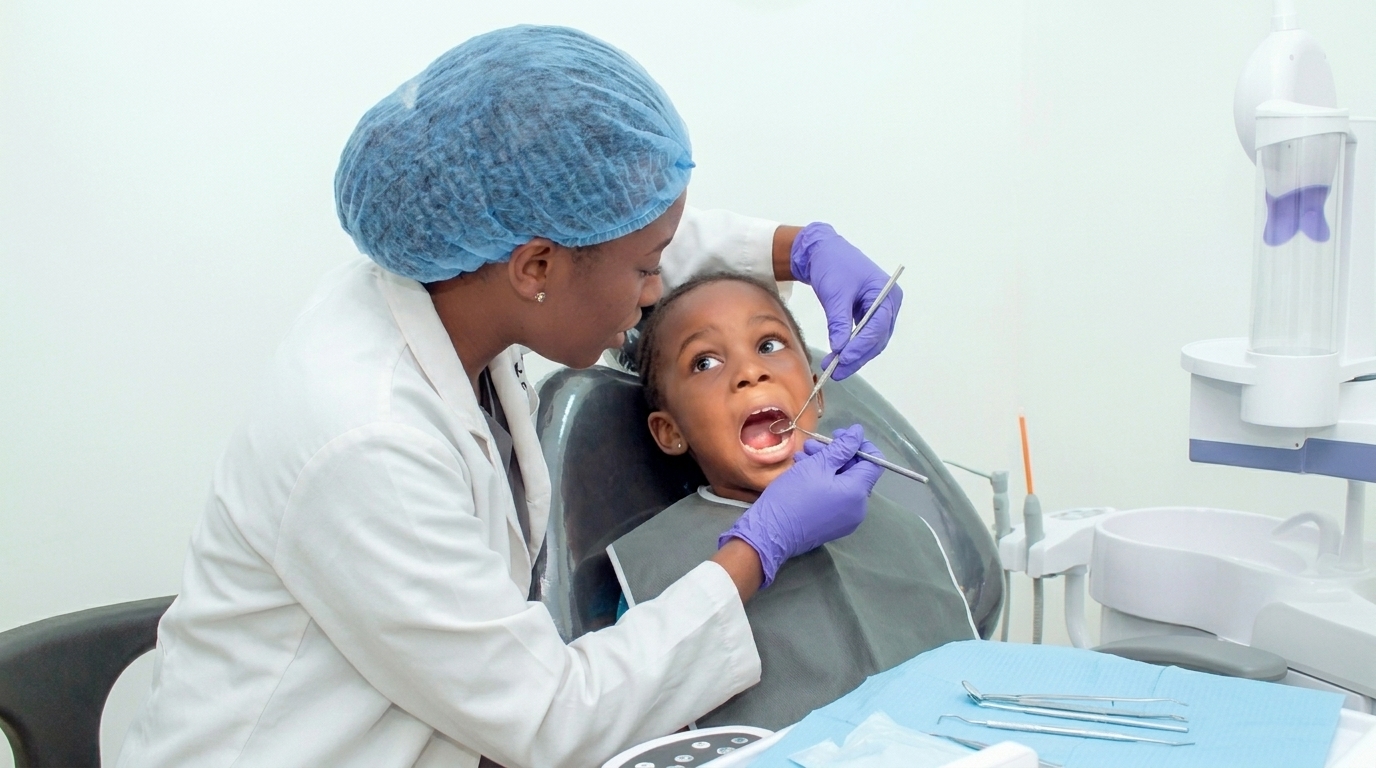
Fissure sealants for children are thin, tooth-coloured coatings painted onto the chewing surfaces of the back teeth to keep food and bacteria out of the deep grooves where cavities often start. Paired with fluoride therapy, which strengthens enamel, they are one of the simplest and most cost-effective ways to protect a child's smile. Applying a sealant involves no drilling and no injections, and each tooth takes only a few minutes.
At Pearl Roots Dental Clinic in Ngong, both treatments are part of our preventive and paediatric care.
What are pits and fissures?
The back teeth (molars and premolars) are not smooth. Their chewing surfaces are covered in tiny pits and narrow grooves called fissures. These are often narrower than a single toothbrush bristle, so even a child who brushes well cannot fully clean them. Food and plaque settle in, bacteria feed on the sugars, and decay can begin quietly inside the groove.
A sealant fills and covers those grooves, leaving a smoother surface that is much easier to keep clean.
How fissure sealants are applied
The process is quick and gentle, which makes it well suited to young patients who may be nervous in the dental chair:
- Clean: the tooth is cleaned and polished so the surface is free of plaque.
- Prepare: a mild solution is applied to help the sealant bond, then rinsed off.
- Dry: the tooth is kept dry, usually with cotton rolls.
- Paint: the liquid sealant is brushed into the grooves.
- Set: a light is used to harden the material in seconds.
- Check: we check your child's bite to make sure it feels comfortable.
There is no drilling and no need for local anaesthetic, because nothing is removed from the tooth. Most children simply describe it as having their teeth painted.
Which teeth are usually sealed?
Sealants are most often placed on the permanent back molars soon after they come through, since newly erupted teeth are especially vulnerable. The first permanent molars usually appear around age six, and the second molars around age twelve. In some cases, deep grooves on baby molars or premolars are sealed too. We will advise on what makes sense for your child after an examination.
What fluoride therapy does
Fluoride is a mineral that helps strengthen tooth enamel and makes it more resistant to the acids produced by plaque bacteria. It can also help repair very early weak spots before they become a cavity.
In the clinic, fluoride therapy is a concentrated treatment painted or applied onto the teeth. It takes a few minutes and is painless. Afterwards your child may be asked to avoid eating or drinking for a short while so the fluoride has time to work.
Sealants and fluoride work as a team
| Fissure sealants | Fluoride therapy | |
|---|---|---|
| What it protects | The chewing surfaces and deep grooves of back teeth | All tooth surfaces, including the sides and between teeth |
| How it works | Forms a physical barrier over grooves | Strengthens enamel against acid attack |
| Drilling or injections | None | None |
| Time in the chair | A few minutes per tooth | A few minutes for the whole mouth |
| Upkeep | Checked at routine visits, repaired or topped up if worn | Repeated at intervals we recommend for your child |
Neither treatment replaces brushing. Twice-daily brushing with fluoride toothpaste, fewer sugary snacks and regular check-ups remain the foundation.
Why prevention is the cost-effective choice
Parents in Nairobi are careful with school fees, uniforms and transport costs, so it is fair to ask whether preventive treatment is worth it. The honest answer is that prevention is usually the most affordable path over the long term.
Consider what happens when a groove decays and is left alone:
- A small cavity needs a filling.
- A larger cavity may need a bigger filling or a crown.
- Decay that reaches the nerve can cause pain, infection and, in some cases, an extraction.
- Each step involves more time in the chair, more time off school and a higher cost.
Sealing and strengthening a healthy tooth avoids much of that. The exact cost depends on how many teeth are treated and your child's needs, and you will receive a clear quote at your free consultation before anything begins. It is premium, careful care for your child at a price that makes sense for a family budget.
Sealants are not a one-time fix forever. They can wear or chip over time, so we check them at every routine visit and repair them if needed.
Fitting treatment around school terms
Because both treatments are quick, they fit easily into a busy family calendar. Some tips from our team:
- Book during school holidays if you prefer your child not to miss lessons. April, August and December holidays are popular, so message us early.
- Pair it with a check-up: sealants and fluoride can often be done at the same visit as a routine cleaning and examination.
- Plan around new molars: if your child is around six or twelve, ask us to check whether new permanent molars have come through and are ready to seal.
We are open Monday to Friday, 8am to 6pm, and Ngong is easy to reach from Karen, Kiserian, Ongata Rongai and Matasia, so an after-school or holiday appointment is usually simple to arrange.
Building good habits early
Gentle preventive visits like these help children build trust in the dental chair. If your child has not yet been to a dentist, our guide to your child's first dental visit explains how to prepare them, and our paediatric dentistry page covers the full range of children's care. You can also read more about preventive dentistry for the whole family, or see how often to book a dental check-up.
Frequently asked questions
Do fissure sealants hurt?
No drilling or injections are involved. The tooth is cleaned, the sealant is painted on and a light hardens it. Most children find it comfortable, although keeping the mouth open for a few minutes can feel tiring for little ones.
How long do sealants last?
Sealants can last for several years, but they can wear down with chewing. We check them at each routine visit and repair or reapply them when needed.
Can my child eat normally after treatment?
After a sealant, your child can usually eat and drink as normal once the appointment is over. After fluoride therapy, we may ask them to wait a short while before eating or drinking. We will give you clear instructions on the day.
Are sealants only for children?
They are most common for children and teenagers, but adults with deep grooves and no decay can sometimes benefit too.